Editorial · Beauty
Waphyto
The powerof Nature
- Conversation with
- Ms. Mikami (CMO)
- Written by
- Geoffrey Guyonnet

Chapters
Chapter 1PLANT BIOMETHODOLOGY
Waphyto starts from a place: Higashi-Mikawa, the eastern part of Aichi Prefecture, where its plants are grown and where the company is based, in Toyohashi. It calls its method plant biomethodology, and describes itself as the first brand in Japan built on it.
The name joins wa, an old name for Japan, with phyto, the Greek for plant. The method comes from the phytotherapist Atsuko Morita, who studied plant therapy in France and then spent some twenty years researching Japanese medicinal herbs. Waphyto combines French phytotherapy with honzōgaku, Japan’s own tradition of herbal medicine, and with modern biotechnology.
The ambition is not simply to put plants into products but to understand precisely what they can do. That is why the brand’s language reaches beyond cosmetics, to the body, the mind, daily habits and the way people live with the plants they use.
The range now runs from skincare and haircare to body care, intimate care, baby care and room fragrance.


Chapter 2WELLNESS ROOTED IN PLANTS
Phytotherapy, the use of plants to support the body’s own balance, is the framework through which Waphyto thinks about care. It is a working method here, not a decorative reference to nature.
Five plants sit at the centre of the range: mulberry, chrysanthemum, gotu kola, mugwort and horsetail, all grown without pesticides in Higashi-Mikawa. The mulberry leaves come from Shinshiro, from a line of trees grown to feed the silkworms whose thread is offered at Ise Jingu.
This shapes what the brand means by efficacy. The goal is not a quick visible result but something slower: healthy skin and hair, a body in balance, and a calmer relationship with daily care.

Chapter 3A BRAND BUILT AS A LIVING CYCLE
For Waphyto, care cannot be separated from the place and the people that produce it.
Plants are not treated as raw material to be extracted, processed and sold. They sit inside a cycle that runs from cultivation through research, formulation and production to daily use.
This is why Higashi-Mikawa matters beyond being an origin on a label. The farmers who grow the plants and the researchers who study them, including a joint study with Kindai University on the mulberry, are not a backdrop to the product. They are among the conditions that allow it to exist.
Working this way means accepting that plants keep their own seasons, that cultivation depends on human care, and that a botanical product takes shape long before it reaches the laboratory.


Chapter 4CARE HAS TO BE FELT BEFORE IT CAN BECOME A RITUAL
Waphyto’s products are meant to make care simpler, not more complicated. They work through texture, scent and touch, and through the plain repetition of use.
Fragrance comes only from natural plant essential oils, textures are gentle, and the botanicals are there to do a job. The products feel calm, but their effect is specific.
The approach is deliberately simple: few steps, close attention to sensory detail. A product does not need to demand attention to change the way someone treats their body.
This is where the brand’s idea of wellness becomes concrete. It does not promise transformation; it relies on small routines that work well enough, and feel natural enough, to keep.


Chapter 5DESIGNED FOR CIRCULATION
Reduce, reuse, recycle, upcycle: Waphyto’s environmental commitment fits in four words. If a product is built from plants, people and a place, its responsibility does not end when the bottle is empty.
Skincare bottles are made primarily from PCR (post-consumer recycled) plastic, cartons from recycled paper made with plant residue, and labels from FSC-certified paper. Until July 2026 the brand’s own shops also collected used containers; Waphyto says it is now working on a successor to that scheme.
The aim is not only to cut waste. The more useful question is how a product’s materials are considered from the start, and what becomes of them after use.
Packaging, in other words, belongs to the brand’s thinking rather than following it.


Chapter 6The process
01DISCOVERING BOTANICAL POTENTIAL
Waphyto starts with plants from Higashi-Mikawa, a region on the Median Tectonic Line, Japan’s longest fault zone, chosen with geologists and agronomists for its soil. A plant is selected for what it can be shown to do, not for how natural it looks.
02PHYTOTHERAPY AND SCIENCE
Each plant is extracted with Waphyto’s patented method, which draws low-temperature steam through the plant under reduced pressure so that its active compounds are not damaged by heat. Phytotherapy sets the direction; research supplies the stability and measurable function.
03DESIGNING WITH RESTRAINT
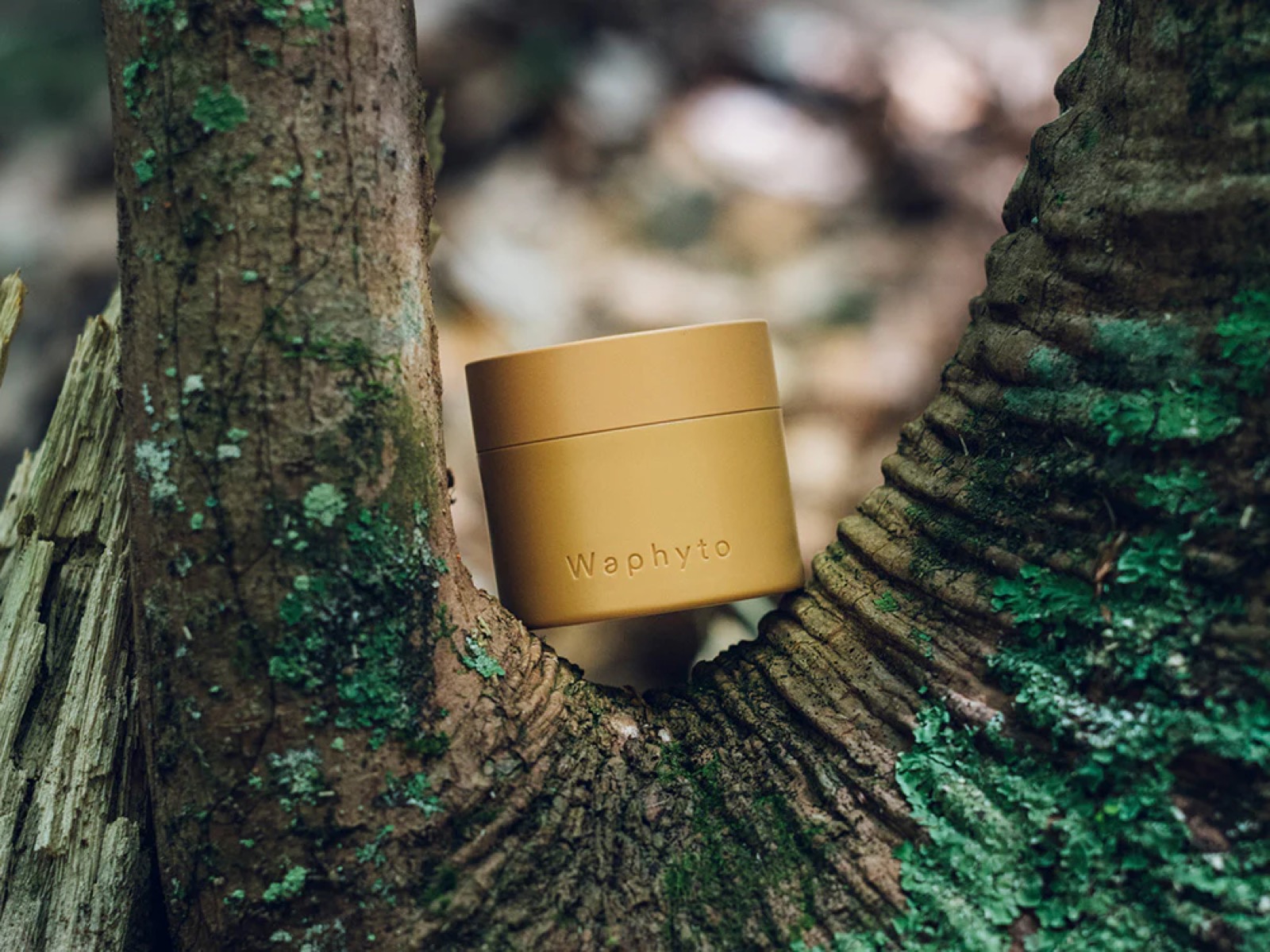
Packaging follows the same restraint: simple forms, earth tones and traditional Japanese colours, fewer materials, and nothing that competes with what the product is for.
04BUILDING CIRCULAR WELLBEING
The work continues after formulation, in the choice of materials and in the local partnerships that supply the plants. The plant, the person, the community and the environment are treated as parts of one system.


Chapter 7BEAUTY IS NOT SEPARATE FROM HEALTH
Waphyto does not treat beauty as a surface problem. Skin, body, mind and habits are seen as connected, each affecting how care is felt in daily life.
A formula can support the skin. A scent can slow a routine down. A texture can make care easier to repeat. None of this is dramatic on its own, but together it shapes how the body is treated over time.
In beauty, nature is often used as atmosphere: a leaf on the label, a botanical name, an image of purity that says little about what the ingredient does. Waphyto takes a stricter line. Its plants are chosen for what they do inside the formula, not for the story they tell around it.
The brand often speaks of Japan’s ‘100-year life’, not as a promise of longevity but as an argument: if lives are longer, care cannot stay occasional. The range follows that logic, from baby care to intimate care around pregnancy and menopause, and the brand names care for older people as its next step.


Honmono notes
A botanical brand that shows its working.
Many brands now talk about plants, wellness, sustainability and ritual, to the point where the words barely register. What makes Waphyto worth attention is its effort to give that vocabulary something to stand on.
The plants are named and tied to one region. The formulas rest on a specific extraction method and on research. The packaging materials are stated. Nothing depends on a single miracle ingredient or a decorative idea of nature.
That is why it holds our interest. Waphyto treats wellbeing as a system rather than an image wrapped around a product, and makes its case through consistency rather than novelty.


Where to find Waphyto