Editorial · Textile
Shinto Towel
Preserving Senshu'sTowel Tradition
- Conversation with
- Mr. Shinto (Company President)
- Written by
- Geoffrey Guyonnet

Chapters
- 01A brand that came after the factory
- 02The need to step forward
- 03A product has to carry the spirit of the person who made it
- 04What is a truly good Towel?
- 05Ato-zarashi, the groundwork
- 06The process of making a Towel
- 07Made in Japan is not an excuse
- 08The afterlife of b-grade towels
- 09Keeping a region able to continue
- ·Honmono notes
Chapter 1A BRAND THAT CAME AFTER THE FACTORY
More than a century of towel-making, carried through the changes in Senshu's industry.
Shinto Towel did not begin as a lifestyle brand. The company was founded in 1907 in Senshu, one of Japan's main towel-producing regions in the south of Osaka Prefecture, and first sold its own products under the name Marushin. As imported towels entered the market and price competition intensified, it moved gradually towards OEM production.
By the time the current president joined, around 90 percent of the business was OEM. The factory was still running and the techniques and knowledge were intact, but the maker itself had become almost invisible behind other companies' names.
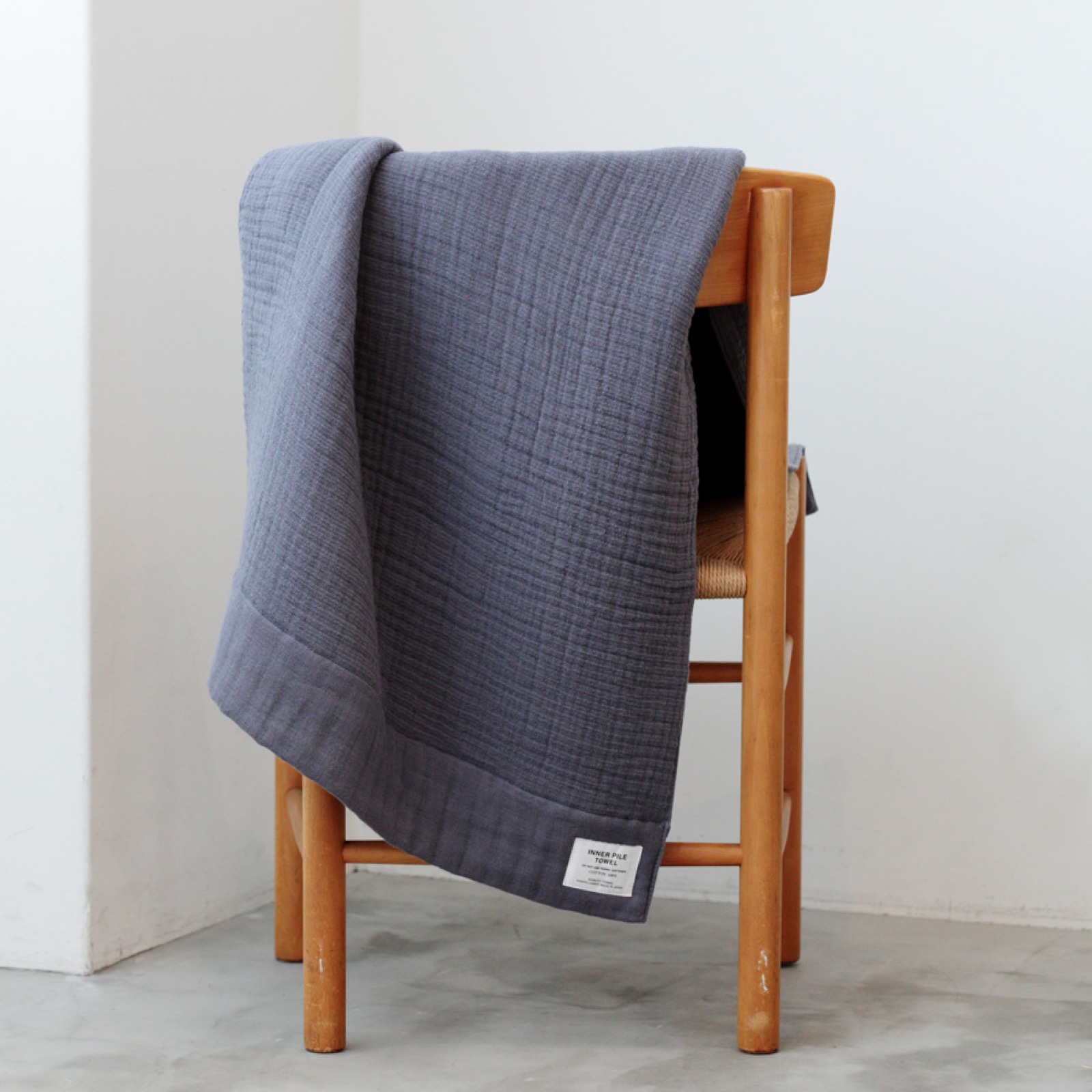
Its own fabrics, such as inner-pile towels, were still being made. They reflected the manufacturer's thinking but rarely carried its name. Shinto Towel, launched as a brand in 2017, was less a fresh start than a return: a manufacturer deciding that if it wanted to talk about its own way of making, it first needed products that bore its own name.


Chapter 2THE NEED TO STEP FORWARD
A brand gave the maker a way to be seen again, through the products themselves.
The decision came after a period of instability. The president's grandfather, who had led the company, died, and the years that followed were spent learning the business, keeping production steady and finding firm ground again.
Only then did the question of what the company should become arise. At around the same time, more Japanese manufacturers were starting to bypass wholesalers and speak directly to customers. Factories were becoming places of communication as well as production.
This mattered for Shinto Towel because it already had techniques and fabrics that only it could make. What it lacked was a visible form for them. As long as those fabrics stayed inside OEM work, the company could not explain where it stood, or show why its way of making deserved to continue.


Chapter 3A PRODUCT HAS TO CARRY THE SPIRIT OF THE PERSON WHO MADE IT
"I wanted to create something that felt fun to make, and that I genuinely liked."
One early reference came from another Osaka towel maker, Fukuroya Towel, which had made towels dyed with the residue of Kawachi wine. What struck Mr. Shinto was not only the idea of reuse but how closely the product matched the person behind it.
That maker liked wine and enjoyed the project. The ecological side was there before sustainability became a marketing term, and the towel felt natural because it grew out of something its maker cared about.
Mr. Shinto took the same approach. Rather than starting from a market position, he began with three products the company already made, each one something he wanted to use himself. The brand grew from handling those products and recognising the company's own thinking in them.


Chapter 4WHAT IS A TRULY GOOD TOWEL?
Quality is hard to pin down because it depends on the person using the towel.
Shinto Towel's central question is simple: what is a truly good towel? The answer is deliberately open. Absorbency, drying speed, texture, density, design and weight all matter, but none of them defines quality on its own.
One person cares most about softness. Another wants a towel that dries quickly in a small flat. Another simply prefers something light, easy to wash and unobtrusive.
For Shinto Towel, the final judgement belongs to the user. A good towel has to suit the way someone lives, and fade into daily use while still carrying the decisions that went into making it.


Chapter 5ATO-ZARASHI, THE GROUNDWORK
"As long as we make towels with ato-zarashi, absorbency remains at a very high level."
Senshu's towel industry is built on ato-zarashi, a washing and bleaching process carried out after the towel is woven. Raw cotton contains natural oils and impurities, and size (a starch coating) is added to the yarn so that it does not break on the loom. Left in the fabric, these make a towel stiff and poorly absorbent.
Ato-zarashi removes them once weaving is finished. The effect is felt in use rather than seen on the surface: the towel absorbs well from the first wash because the cotton has already been returned close to its natural state.
The process is central to Senshu's identity. Here tradition is a set of technical decisions built into the fabric, which you notice every time the towel meets water.


Chapter 6THE PROCESS OF MAKING A TOWEL
01BEGINNING WITH COTTON AND YARN
Production begins before weaving. Cotton yarn is chosen for the weight, softness, absorbency and drying speed the towel should have. That choice already decides how it will behave after years of washing.
02WEAVING THE TOWEL IN ITS RAW STATE
The towel is woven while the yarn still carries its natural oils and the added size, which protects it from breaking on the loom and keeps the fabric stable as it forms. At this stage the towel is not yet usable.
03ATO-ZARASHI, THE SENSHU PROCESS
This is where Senshu differs from other towel regions. In Imabari, the best-known of them, the yarn is washed before weaving. Senshu weaves first and washes afterwards, and the result is a different hand and absorbency.
04FINISHING THE TOWEL
After ato-zarashi, the towel is dried, softened, cut and sewn. These stages set its final hand and shape.
05INSPECTION
Each finished towel is inspected closely, including for small flaws that do not affect how it works.


Chapter 7MADE IN JAPAN IS NOT AN EXCUSE
"I never want to say: it is good only because it is made in Japan."
Especially outside Japan, it is tempting to let the words "Japanese quality" explain everything. Shinto Towel resists that shortcut. Mr. Shinto accepts that being made in Japan helps how a product is perceived, but he will not treat the label as proof.
For him, the quality that matters is less visible. It lies in attention to the other person: in inspection, and in the moment a maker hesitates over a flaw that does not affect function and asks whether a customer would be bothered to see it on a shop shelf.
That care does not need to become a slogan. It is the standard the company holds itself to before a towel reaches the person who will use it.


Chapter 8THE AFTERLIFE OF B-GRADE TOWELS
"What is a B-grade product? That question itself becomes part of the project."
Shinto Towel avoids simply selling B-grade towels at a discount. For a towel brand, that matters. People do not replace towels every season, and some keep the same one for years. If discounted seconds become something customers wait for, the value of the regular product starts to erode.
Instead, the company looks for other uses. One is YUKINE BITS, small half-size handkerchiefs made by cutting the usable parts from rejected YUKINE towels and hemming them again. The flaw disappears in the new format.
Another project turns B-grade pieces of the 2.5-PLY GAUZE line into shirts, cut as little as possible so as not to create fresh waste. In both cases the aim is to give the material a second use without undermining the value of the original product.


Chapter 9KEEPING A REGION ABLE TO CONTINUE
"If the production area does not remain, we cannot make towels."
Mr. Shinto keeps coming back to Senshu, less as a backdrop than as infrastructure. Towel production there depends on a local division of labour: weaving, washing, dyeing, finishing, sewing and inspection are handled by different people and companies.
If one link weakens, the whole chain becomes fragile. Processing partners who are constantly pushed down on price cannot make a profit, and without a profit they cannot train successors.
For Shinto Towel, supporting the region means not haggling every partner down, accepting price increases when they are necessary, and creating work that lets others carry on.
The towel is the visible result. Behind it is a longer-term aim: to keep the regional system going long enough for a new generation to join it.


Honmono notes
A towel is a small domestic object, but it can also be read as a record of a region, a process and a way of thinking about use.
What stayed with us after the conversation was the way Mr. Shinto spoke about making. He did not treat quality as fixed, but as something that depends on the person using the towel, the life around it, and the small annoyances or pleasures it brings each day.
Seen that way, a towel is the result of choices made for different users and different ways of living, not just a list of qualities such as absorbency or softness.
The factory shows the same attitude. Shuttle and rapier looms, some more than half a century old and no longer manufactured, are still in use. The craft is kept up, not frozen, and the work is practical and exact.
Shinto Towel holds these things together: a regional method, a manufacturer's sense of responsibility, and the wish to make something personal. Its towels are not meant to suit everyone, but they are considered enough to suit someone.


Where to find Shinto Towel