Editorial · Jewelry
TOCT
Putting kintsugiback on the body
- Conversation with
- Ms. Nakamura (Director) and Ms. Miyake (Designer)
- Written by
- Sakura Yamamoto

Chapters
Chapter 1It started before the company
A young Tokyo jewellery brand bringing a centuries-old Japanese craft back into daily life
TOCT did not begin as a jewellery brand. It began as a private practice. Before the company existed, Miyake had been doing kintsugi for some time, purely out of personal interest, the kind of thing you take up because you want to slow down. She liked the patience it asks for: the waiting, and the way a cracked bowl, after weeks of careful work, goes back into use with a thin line of gold across it.
When Nakamura began talking about starting a jewellery line, Miyake raised an idea almost in passing. What if the gold line ran across a ring instead of a bowl? That conversation became the brand.
Nakamura describes her starting point in terms of memory rather than innovation. "When I think about traditional crafts today," she told us, "I get the feeling they've become something you only see in museums. Something too special to touch." For most of Japanese history, she points out, craft was the opposite: the bowl on the family table, the cup someone used every morning.
TOCT sets out to bring that closeness back.


Chapter 2Why jewellery
“We make jewellery, yes, but in our minds we are making craft pieces. Jewellery just happens to be the form.”
We asked Nakamura why she chose jewellery, of all the possible forms for kintsugi. Her answer was simple.
She loves jewellery and wears it every day. For her it is not decoration but part of how she dresses, almost part of herself, as she puts it. When the question of what to make came up, jewellery was the obvious answer.
There is a sharper logic beneath the personal preference. Kintsugi pieces, like most Japanese crafts, tend to end up somewhere reverent: a shelf, a glass case, a box at the back of a cupboard. They are admired, but rarely used.
A piece of jewellery lives differently. It goes with the wearer to the office, to dinner, to the airport, and gathers a person's days. "If craft only lives on a shelf," Nakamura said, "it stops belonging to anyone. We wanted to make something you could actually wear into your life."


Chapter 3A jewellery brand that thinks of itself as a craft house
Officially, TOCT is a jewellery brand. The founders are quick to point out that this only describes the surface.
In Miyake's words, what they make are kogeihin, craft pieces, which happen to take the form of rings, earrings and ear cuffs.
The distinction shapes how the brand works. A jewellery label tends to organise itself around collections, trends and seasonal launches. A craft house works on a slower timescale: the relationship between an object and its owner, over years. The brand's three taglines say as much: Art you wear. Beauty in imperfection. With you, forevermore.
Together they describe one aim: to make something a person will keep, and keep wearing, for a long time, perhaps long enough to pass it on.


Chapter 4Quality as a relationship
Behind TOCT sits a question more than a position: what does it mean for an object to belong to someone? The founders' answer is deliberately personal.
Materials matter: the cleanness of the silver, the line of the gold, the weight in the hand. But none of these alone decides whether a piece becomes meaningful to someone.
One person cares about the irregularity of the kintsugi. Another notices the precision of the silver. Another simply wants something that feels right when worn.
For TOCT, the final judgement belongs to the wearer. A piece can meet every technical standard and still fail to fit into someone's life. What counts is not whether it is beautiful in isolation, but whether it suits the person who chose it.


Chapter 5Digital precision, a human hand
“Rather than recreating traditional craft in its original form, we combine contemporary silver-making techniques with kintsugi, to explore how craftsmanship can exist within a modern design language. It lets us make forms that feel contemporary while keeping the depth and spirit of traditional craft.”
At first sight, a TOCT piece does not look traditional. The shapes are clean, the circles exact, the lines sharp. If you assumed they were shaped by hand, you would be wrong.
“If we shaped the silver by hand, the work would start looking old almost without us noticing.”
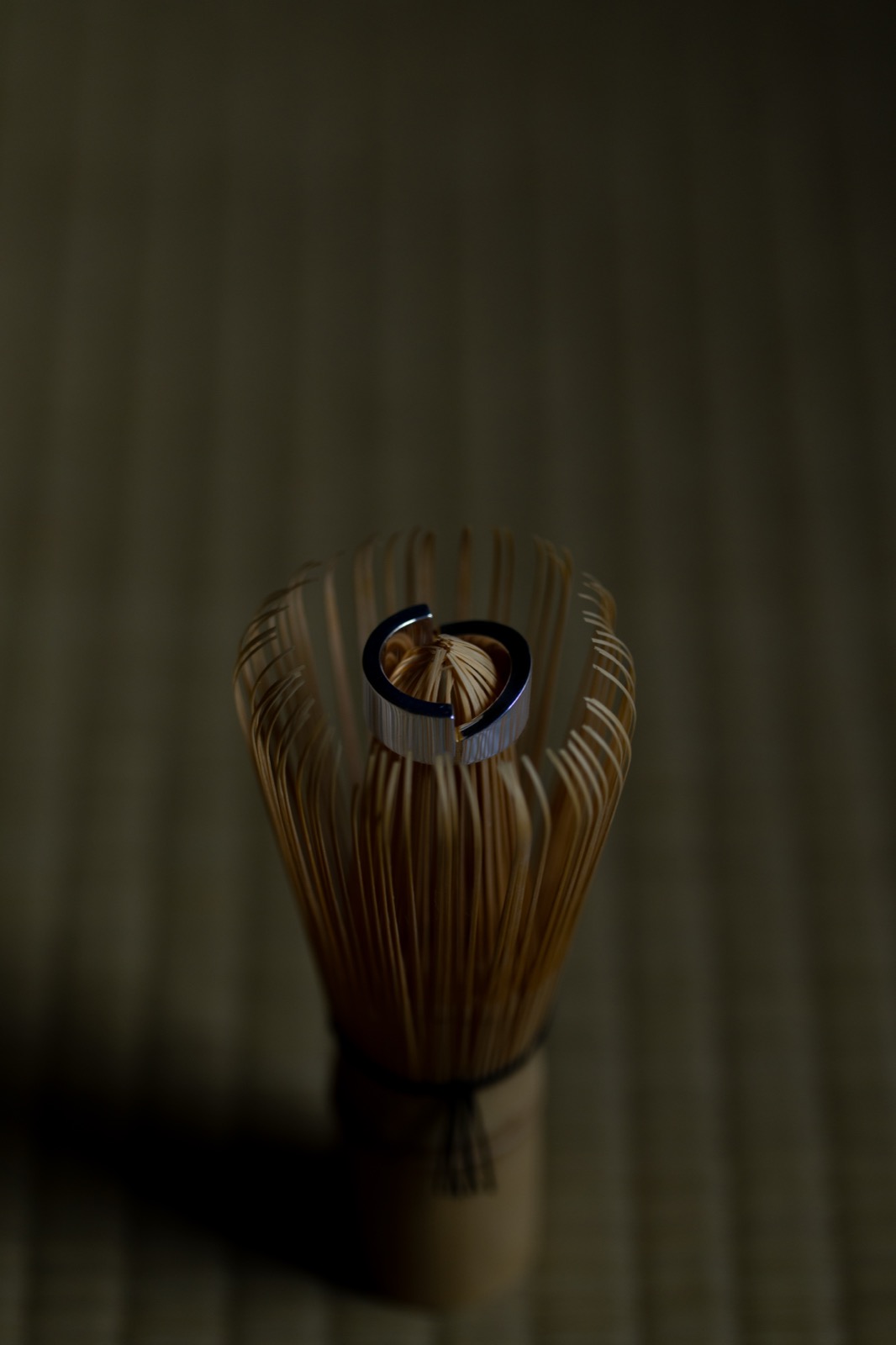
The precision is deliberate. The silver is designed digitally and made with the kind of geometric accuracy that only modern fabrication gives. The kintsugi is then applied by hand on top of it, and the gold line is irregular. It catches the light differently on every piece and carries the small, unrepeatable marks of the person who made it.
That contrast is the point: a perfect circle crossed by an imperfect line of gold. It is what keeps the pieces contemporary rather than nostalgic.


Chapter 6How a TOCT piece is made
01Designing the shape in 3D
Every TOCT piece starts on a screen. The silver form (the ring, the earring, the cuff) is modelled digitally until its circles, lines and proportions hold their balance. Already at this stage, the piece is being designed for how it will sit on the body.
02Casting the silver base
Once the model is final, it is cast in silver. The base is then finished and polished: clean enough to read as a modern object, and ready to receive the part of the work that cannot be designed on a screen.
03Applying the urushi
This is where the work passes from machine to hand, and it is done by Miyake herself.
Before any gold, she applies urushi, natural lacquer, mixed with different traditional materials depending on the stage: kokuso (a urushi putty) and sabi-urushi (urushi mixed with fine clay powder), both used in kintsugi repair. She works it by hand into the grooves and chipped areas of the piece.
The surface is shaped and refined over several stages, rarely in a single application. These small, repeated adjustments are what give every piece its own line.
04The waiting
Each application of urushi takes around a week to harden, in a room kept at a steady temperature and humidity, and there is no way to hurry it. Several rounds may be needed. According to TOCT, the urushi on a kintsugi piece needs one to one and a half months to cure fully.
05Gold finish and inspection
Gold powder is laid over the cured urushi to complete the line. Each piece is then inspected individually, with the knowledge that it is going to a particular person and will be worn for years.
For TOCT, this attention is what Japanese craft means: care for the person who will wear the object, rather than perfection or a national label.


Chapter 7Japan, not as a claim
“Being Japanese is not a claim. It is what made us capable of making this in the first place.”
We asked Nakamura what being a Japanese brand means to her. Her answer was careful, and a little wary of the question.
She and her co-founder are clear that being Japanese is not a value in itself. Plenty of brands lean on the label; TOCT prefers not to.
What they point to is subtler: a way of paying attention to objects, a reflex to repair rather than replace, consideration for the person on the other side of every exchange.
None of this, Nakamura said, was learned formally. It was absorbed at home, at school, in the small gestures of everyday life in Japan. That, more than the gold or the urushi, is why the work feels the way it does.
"I can't make twenty of these in a day," Miyake said. "I make one at a time, and I prefer it that way."


Chapter 8Made to order, by necessity
Made to order is often a marketing position. For TOCT, it is closer to a constraint than a choice.
"Kintsugi takes time," Miyake said of the hand work, almost apologetically. "I do every step myself. There is no way to scale this."
The constraint has become part of how she works. When an order comes in, Miyake knows who the piece is for. She thinks about their hands, their fingers, the moment they will first put it on, and she is convinced that awareness goes into the work.
The customer, too, receives a piece differently after waiting for it.
TOCT increasingly sees this as what sets it apart. In a market built on faster shipping and bigger drops, it offers the opposite, and the people drawn to it tend to understand why.


Chapter 9Bringing kintsugi back into daily life
“We are not trying to multiply experiences. We are trying to restore a daily relationship with craft.”
We ended by asking where TOCT sees itself in ten years. Nakamura laughed at the timeframe, then answered without hesitating.
She came back to where she started: traditional craft in Japan used to live inside daily life, and has drifted away from it. She would like to help reverse that, as one brand among others. TOCT's part, she hopes, is to introduce people to kintsugi as something they wear, and let curiosity lead them further into Japanese craft.
There is a more concrete plan too. Today TOCT sells online. In ten years the founders would like a physical shop, in Japan or elsewhere, with a fully trained kintsugi artisan on site, making and repairing pieces in front of visitors.
That artisan need not be Japanese. "If someone has carried this practice forward seriously enough to belong to it," Nakamura said, "they belong to it. That's enough for us."
Abroad, kintsugi is often reduced to a workshop, something you try once and bring home as a story. For TOCT it is a practice of repair, and what matters is what people do after learning it: what they choose to mend rather than throw away.


Honmono notes
After a couple of hours with Nakamura and Miyake, TOCT feels less like a jewellery brand than a small craft house that happens to work in rings and earrings.
What stayed with us was how often both founders came back to the same idea: an object should belong to a person, not to a season. The rest (the made-to-order rhythm, one pair of hands on the kintsugi, the refusal to scale) follows from it.
The 3D modelling was the part we hadn't expected. The silver is machine-precise; the gold line on top is uneven by design. Having the two side by side, without pretending the silver is handmade, is an unusually honest way to make jewellery, and you can see it in the finished piece.
On the body, the pieces say two things at once. The shape says modern. The gold line says broken and repaired. Miyake put it more directly: imperfection, once accepted, is not a flaw.


Where to find TOCT