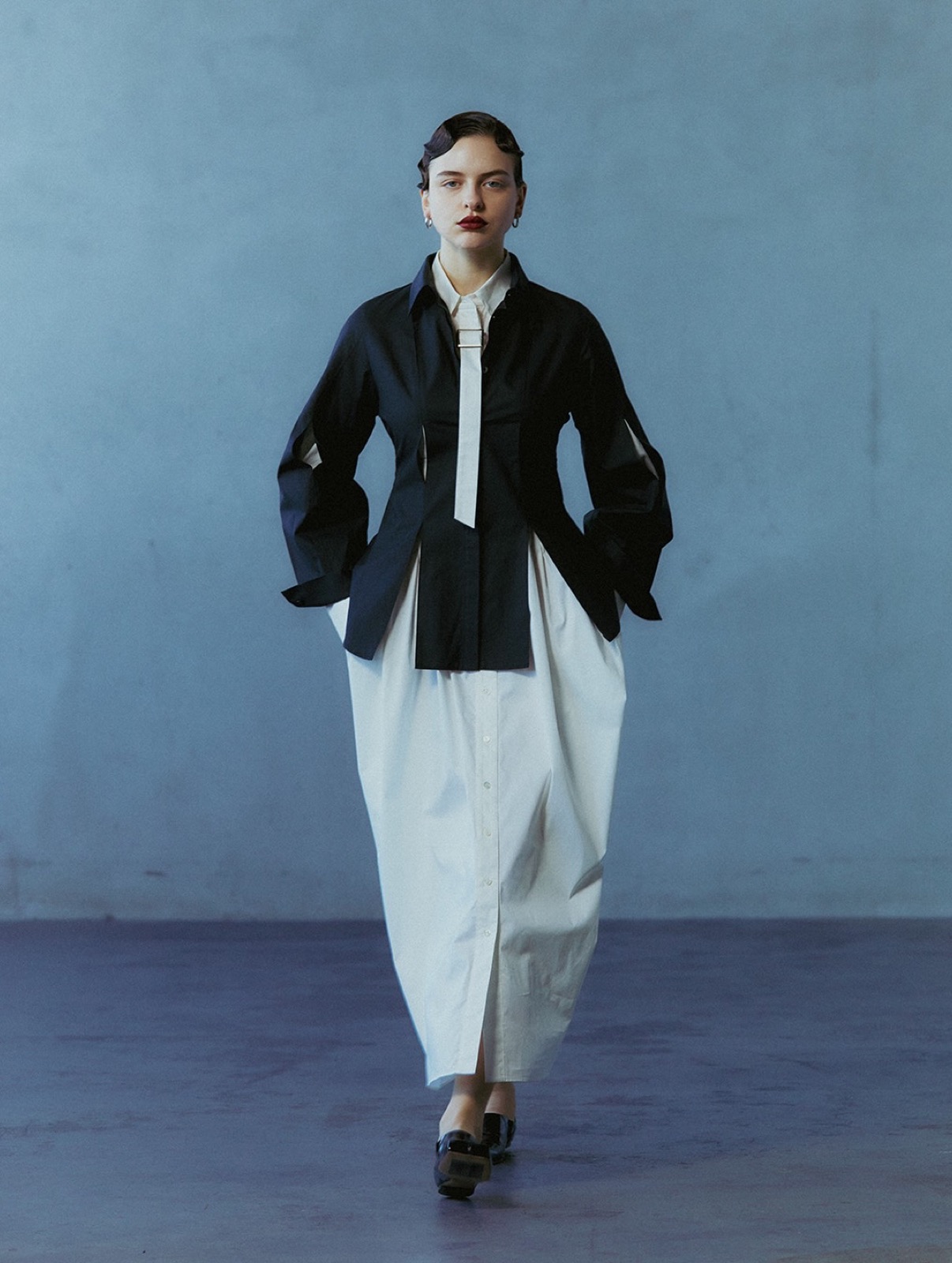
Editorial · Fashion
URUH
A wardrobe madefor the in-between
- Conversation with
- Kanako Ohmori (Designer) and Ritsuko Matsuyama (Co-Founder)
- Written by
- Geoffrey Guyonnet

Chapters
- 01A brand born on a factory floor
- 02Why clothing, and why this name
- 03A fashion label built with its mills
- 04What URUH means by quality
- 05Traditional weaving, contemporary silhouette
- 06The process behind URUH
- 07Slow is not the point: traceability is
- 08Sustainability, redefined
- 09Japan as part of the story, not the pitch
- ·Honmono notes
Chapter 1A BRAND BORN ON A FACTORY FLOOR
URUH did not begin in a sketchbook. It began on the floor of a small weaving mill in Nishiwaki, in Hyogo Prefecture.
The designer, Kanako Ohmori, had spent her whole career in the apparel industry. She studied at an art college in Kyoto, then taught herself in London: an internship at A Child of the Jago, the label co-founded by Vivienne Westwood's son, and hand-stitching on a collection for the ITS competition while working for a Japanese tailor on Savile Row. Back in Tokyo she joined the fabric planning team of one of Japan's internationally known fashion brands, then spent four years co-leading an in-house designer label within a larger group.
In all that time she had been making "Made in Japan" clothes without ever learning the names of the mills that wove the fabric. Everything passed through OEMs and swatch books. The makers were somewhere at the far end of the chain, out of sight.
The change came through her future co-founder, Ritsuko Matsuyama, who had moved from apparel into regional revitalisation work with local government, including a three-year posting with the city of Kobe. In her own time she had been visiting small textile mills, and one day she suggested they go together to a husband-and-wife mill in Nishiwaki.
What Ohmori saw there changed the question. She watched a loom at work for the first time, and saw the techniques behind fabrics she had used for years. She also saw jacquards being woven, under strict confidentiality, for major luxury houses. The people who made them could not put their own name on the cloth.
URUH grew out of that gap. It launched in autumn/winter 2023 with an explicit purpose: to make those mills, and the way they work, visible.


Chapter 2WHY CLOTHING, AND WHY THIS NAME
The name URUH comes from 閏 (uruu), the Japanese word for "leap", as in leap year or leap second.
The leap second is the odder of the two. To keep clocks in step with the earth's rotation, an extra second is occasionally added at the end of a day: 23:59:60, before the clock turns to 00:00:00. A second that should not exist, inserted because something doesn't quite fit.
Ohmori has been drawn to that kind of space all her life: things that are uncertain, in between, loose enough that each person sees them differently. In her words, it is the puzzle piece that belongs to no one, dropped in to fill a gap nobody else had noticed.
Clothing felt like the right medium. Garments are worn close to the body and gather a person's days. Other people read them constantly, and the wearer keeps rereading them too. Whatever ambiguity the designer has in mind ends up travelling on someone else's shoulders.
The product names make the idea explicit: INTERSTICE Slit Shirts, MAZE Cocoon Pants, INORGANIC Flared Pants, NO SILHOUETTE Shirts. They describe the brand's real subject.


Chapter 3A FASHION LABEL BUILT WITH ITS MILLS
Ohmori brings the mills a feeling. The craftsmen answer with a technique.
On paper, URUH is a small Tokyo fashion label. In practice, the founders describe their work less as design followed by sourcing than as a running collaboration with a network of Japanese weaving and dyeing workshops.
Ohmori usually starts from something emotional: a concept, a hand-drawn illustration, a mood she wants to turn into cloth. She takes it to the mills, and the craftsmen suggest techniques that might carry it. One example she gave: she had wanted to use opal fabric, a burnt-out finish whose production can involve heavy water use and chemical processing. An artisan proposed Gisha-ori (擬紗織り) instead, a mesh-like weave long associated with summer kimono, as a more sustainable route to a similar look.
Most of the collection takes shape through that kind of exchange. The designer brings a mood; the mill brings its knowledge of how cloth has been made for generations. The garment comes out of the meeting between the two.


Chapter 4WHAT URUH MEANS BY QUALITY
Ohmori compares each garment to a novel: something you read slowly, and that means more the longer you live with it.
It is a comparison she returns to often. The wearer spends time with a piece and reads it slowly, and over months and years it gathers a meaning that no summary could reproduce.
Ask a chatbot to summarise a novel, she notes, and you get the plot, but not what the book becomes once you have lived with it.
The idea shapes how the label is run. Production volumes are deliberately small. Each piece is meant to carry its own story: the mill that wove the fabric, the craftsman who dyed it, the conversation that gave it its shape. The wearer is meant to know that story, or at least to sense it.
It also changes the marketing question. URUH is not trying to reach as many people as possible. It wants long relationships with a smaller number of people who choose to spend time with the work.


Chapter 5TRADITIONAL WEAVING, CONTEMPORARY SILHOUETTE
"It's not about deciding tradition is good and machines are bad. The craftsmen carry decades of memory in their hands. That's what I want next to a modern silhouette, not against it."
URUH relies heavily on textiles from Japan's traditional weaving regions, but its silhouettes are clearly contemporary.
Gisha-ori is the clearest example. The open weave that kept summer kimono cool is cut here into a straight-line dress. The fabric keeps its lightness and breathability; the cut puts it in a present-day wardrobe.
The buttons follow the same logic. They are shell buttons made to order in Nara Prefecture, with original engravings, so each one has a known origin and maker.
What Ohmori values most in traditional weaving is the thinking built into it. A jacquard that looks simple from a distance is, up close, the result of decisions about every warp and weft thread, made by someone with decades of experience. She has nothing against new technology such as 3D printing or machine production, but for her, hand-weaving carries a human density that newer methods cannot yet match.


Chapter 6THE PROCESS BEHIND URUH
STEP 1 | STARTING FROM AN EMOTION Each collection begins with a concept and a set of hand-drawn illustrations. Ohmori works from a feeling or an image before any fabric is chosen.
STEP 2 | THE CONVERSATION WITH THE MILL The illustrations and the mood go to URUH's partner mills. The artisans respond with proposals, a particular weave or dyeing method, that could translate the brief into cloth.
STEP 3 | WEAVING OR DYEING THE FABRIC The chosen technique is carried out at the mill: jacquard, Gisha-ori, hand-tied dot dyeing or others, depending on the collection. Each method has its own pace; the dyeing in particular is done by hand, one piece at a time.
STEP 4 | CUTTING THE SILHOUETTE URUH cuts the fabric into shapes that take the textile out of its original context. A summer-kimono weave becomes a straight-line dress; a Kiryu jacquard becomes cocoon trousers.
STEP 5 | DETAILS BUILT FOR LONG WEAR Custom buttons, replaceable collars and cuffs, and finishes that let the garment be repaired or refreshed over the years.


Chapter 7SLOW IS NOT THE POINT: TRACEABILITY IS
Each piece is dyed by hand, one at a time. When a pattern comes out slightly irregular, URUH treats it as a trace of the hands behind the work, and as part of the piece, not a defect.
Traditional methods are not built for efficiency, and URUH does not pretend otherwise. Deadlines slip when an artisan needs rest. Patterns vary from piece to piece. Production cannot be rushed.
For Ohmori, though, slowness is not what the brand is defending. What matters is traceability: for every piece, the wearer can know which mill wove the fabric, which artisan dyed it and which workshop made the shell buttons.
That approach fits the European Union's planned Digital Product Passport, which will require brands to disclose, item by item, where components were made and how a product can be repaired or recycled. For textiles it is expected to become mandatory from around 2028, once the EU adopts the detailed rules for the sector. For most of the apparel industry, compliance means piecing information together across opaque OEM chains. URUH already holds that information, because the brand was set up around it.


Chapter 8SUSTAINABILITY, REDEFINED
"If you commit to organic-only or coffee-dye-only, your expression gets boxed in. Our sustainability is about wearing the piece for a long time."
For a brand of its size, URUH takes an unusual line on sustainability: it does not lead with single-material claims or certifications.
Instead, the founders measure it by one question: how long does the wearer keep the piece in use? The range is built around shirts that can be worn all year, with replaceable collars and cuffs on selected styles, since those are the parts that wear first. Fabrics mix natural fibres, regenerated fibres such as cupra, and recycled polyester where it suits the piece.
Where a technique can be swapped for one with less water and chemical waste, the brand does so, as with Gisha-ori in place of opal fabric.
The larger bet is on the wearer. A garment the buyer comes to think of as their own, with a story they know and makers they could name, tends to stay in use far longer than average.


Chapter 9JAPAN AS PART OF THE STORY, NOT THE PITCH
"I'd love for international customers to fall in love with URUH's story first, and then realize the Japanese artisans behind the work share the same care. The other way around doesn't really work for us."
The founders are clear about how they want URUH to be read outside Japan. They did not want to sell it abroad on the basis that it is Japanese.
They have noticed what many Japanese brands report: in Europe especially, customers want the who, the why and the how before they look at the object. The story is the way in. In Japan, products more often lead with the what: function, precision, specifications.
URUH is built for the first kind of attention. Its subject is the idea of the in-between, the leap second, and the way Ohmori turns that into clothes. The Japanese fabrics, the techniques and the named workshops belong to the story rather than the headline. In the founders' view, "Made in Japan" is no longer enough of a pitch on its own.
Honmono notes
URUH is, at heart, a label about what happens between things.
What stayed with us after the conversation was how often Kanako Ohmori came back to the same image: clothing as a novel, the wearer as its reader, a piece that gathers meaning over time.
Behind the literary comparison, the label is carefully organised. Its design process starts at the mill, with a conversation rather than a finished brief. Its sustainability rests on long use rather than single-material claims. And its supply chain is already traceable in the way new European rules will soon require.
It is rare to find a fashion label this philosophical and this practical at once. URUH belongs to a small group of Japanese brands that no longer want to sell Japan as a label, and would rather bring the unseen parts of Japanese making, the mills, the artisans and their techniques, into the open.


Where to find URUH