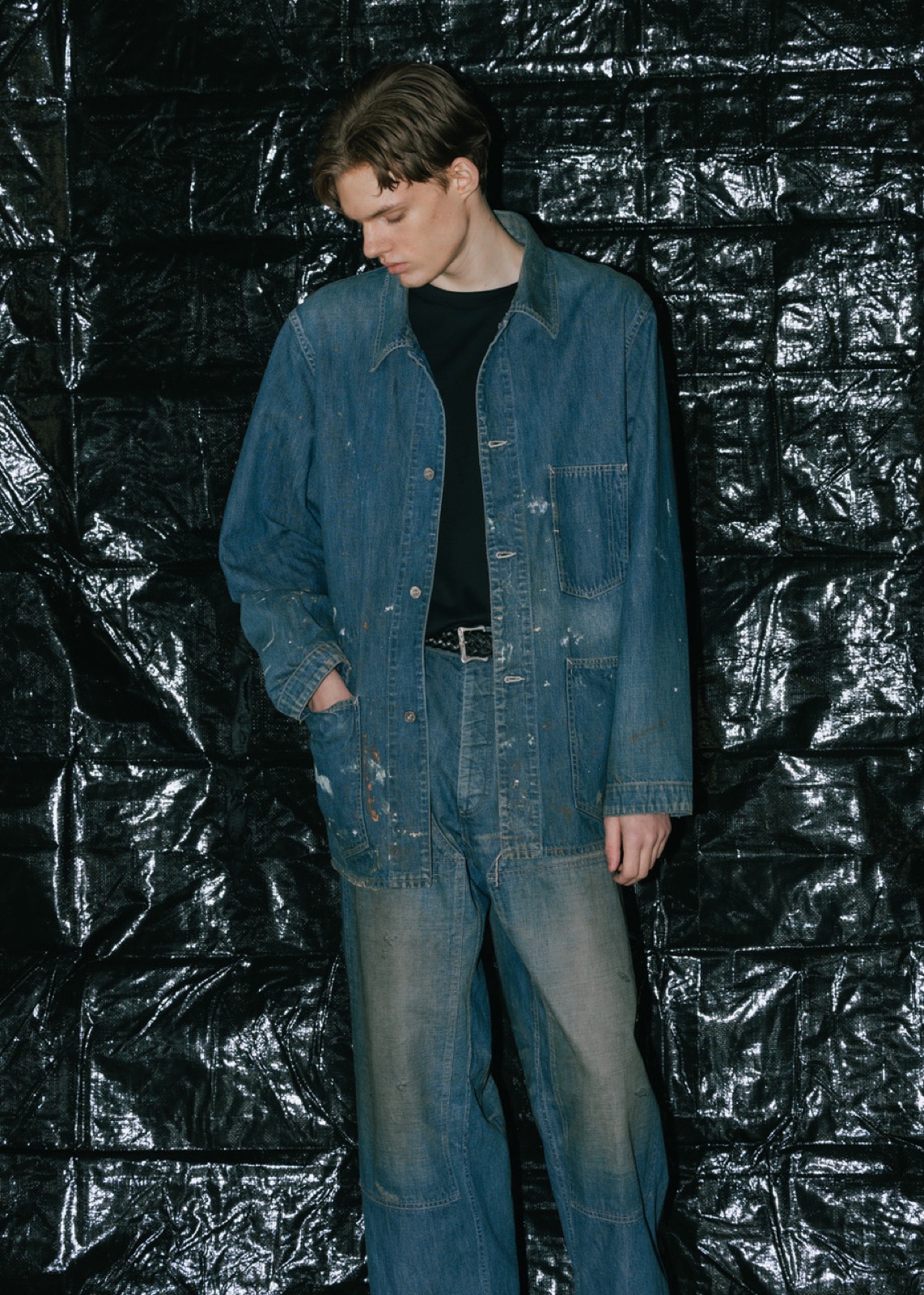
Editorial · Brand Feature
FILL THE BILL
Built onArchival Research
- Conversation with
- Junichi Kaneda (Founder & Designer)
- Written by
- Geoffrey Guyonnet

Chapters
- 01Reworking THE archive through Japanese production
- 02Defined by what is necessary
- 03Made across Japan by specialist workshops
- 04From production work to a label of its own
- 05Clarity through removal
- 06How FILL THE BILL garments are made
- 07Clothing that develops through wear
- 08Keeping THE workshops going
- ·Honmono notes
- ·Final reflection
Chapter 1REWORKING THE ARCHIVE THROUGH JAPANESE PRODUCTION
FILL THE BILL starts from old clothes. Each garment begins with a familiar reference, which is then pared back and rebuilt in Japanese fabrics and Japanese factories.
FILL THE BILL does not build its collections around seasonal themes. It works from an archive of garments, images and cultural references that Junichi Kaneda has collected over many years. Each season begins with research: studying the history of a type of clothing, choosing particular pieces and taking them apart, both as ideas and as constructions.
The aim is not reproduction. The archive is a starting point. Through fabric development, sewing, proportion and silhouette, the original is reworked into a contemporary garment.
The clothes are recognisable, but clearer than their sources. They do not depend on loud detail or novelty. What gives them their character is restraint, the way a fabric falls and the precision of the decisions that are left.


Chapter 2DEFINED BY WHAT IS NECESSARY
Every garment is developed by asking what it actually needs: the fabric, the construction, the silhouette.
Nothing is overstated. Details stay close to their function, and proportion and material do most of the work.
The effect is a garment that does not ask to be noticed. Its qualities show slowly, as it is worn.


Chapter 3MADE ACROSS JAPAN BY SPECIALIST WORKSHOPS
Each FILL THE BILL garment passes through several Japanese workshops, each responsible for one stage of the process.
All FILL THE BILL clothing is made in Japan, through a network that spans several regions and trades. Rather than relying on a single anonymous supply chain, each stage goes to a workshop that specialises in it.
Fabric is developed in Okayama and Fukuyama, and processed in Okayama. Dyeing is done in Kyoto. Sewing takes place in Yokohama, Okayama, Hiroshima and Kyoto, and specialist workshops carry out the final inspection.
The brand produces only what it needs and keeps working with the same people over time, a choice that matters more as these workshops come under strain (see Chapter 8).


Chapter 4FROM PRODUCTION WORK TO A LABEL OF ITS OWN
Before FILL THE BILL existed, Kaneda worked behind the scenes, developing garments for other companies through OEM and ODM production.
That background still shapes how the brand works. The questions were always practical ones: how a garment is cut and sewn, how a fabric behaves, how a piece can be made consistently without losing its character.
The turning point came when a close acquaintance saw a sample Kaneda had made for a client proposal and suggested the work deserved its own name. What had been made for others became the basis of an independent label.
FILL THE BILL was launched in Tokyo in 2012. It grew out of production knowledge rather than out of an image.


Chapter 5CLARITY THROUGH REMOVAL
Design here works by subtraction. Instead of adding decoration, each version removes something, until fabric, construction and silhouette are left to define the garment.
The form becomes clearer with each round of adjustment. What remains is clothing that adapts to the person wearing it rather than imposing itself.


Chapter 6HOW FILL THE BILL GARMENTS ARE MADE
01MATERIAL SELECTION
Fabrics are chosen for how they will change through wear, not only for how they look new: how they soften, how they hold their shape, and how they respond to washing and daily movement. Durability matters as much as texture.
02PRODUCTION ACROSS JAPAN
Each stage goes to a specialist workshop, from the fabric mills of Okayama and Fukuyama to the dyers of Kyoto and sewing factories in four cities. Close coordination keeps the garment consistent from cloth to finished piece while drawing on what each workshop knows best.
03FINISHING AND INSPECTION
The final stages check balance, proportion and how the garment behaves when worn. Seams, silhouette, surface and overall structure are reviewed before a piece is considered finished and ready for long-term use.


Chapter 7CLOTHING THAT DEVELOPS THROUGH WEAR
For FILL THE BILL, a garment is not complete at the moment of purchase. It keeps changing through wearing and washing, as the fabric and structure adapt to the body.
This is part of the design. The clothes are not made for immediate impact but to settle over time, as the material softens and the shape adjusts to the wearer.
Use leaves traces, and those traces give each piece a quiet individuality. The relationship between garment and owner becomes part of its finished form.


Chapter 8KEEPING THE WORKSHOPS GOING
Many of the specialist workshops FILL THE BILL relies on are under pressure, and skills built up over decades are becoming harder to sustain.
Across Japan, small production workshops face rising costs, shrinking networks of suppliers and, often, no one to take over. FILL THE BILL's response is a controlled way of making: producing only what is necessary, and returning to the same workshops season after season. The goal is stability rather than scale.
Each piece therefore reflects a set of relationships as well as a set of materials. Continuing to make clothes this way helps keep those workshops in business.


Honmono notes
FILL THE BILL is a brand built on a method rather than a visible signature.
Its starting points are existing garments, drawn from workwear, military clothing and other archival pieces. These are refined through fabric and construction, with unnecessary elements removed and the work kept within a stable network of Japanese workshops.
The value of the clothes is not immediate. It builds through wear and through the conditions in which they are made.


Final reflection
FILL THE BILL shows how an archive can feel contemporary without turning into costume.
The brand rests on a close link between research and making. Its garments carry references without being bound by them: the archive sets the direction, and production gives it form.
What makes it worth attention is the patience of the process. It does not chase novelty, and it does not present craft as decoration. It works through cloth, proportion and manufacturing, and leaves time to do the rest.
That is why it sits comfortably within Honmono: a brand that uses Japanese production not just as a place to manufacture, but as a way of thinking about what clothing can be.


Where to find FILL THE BILL