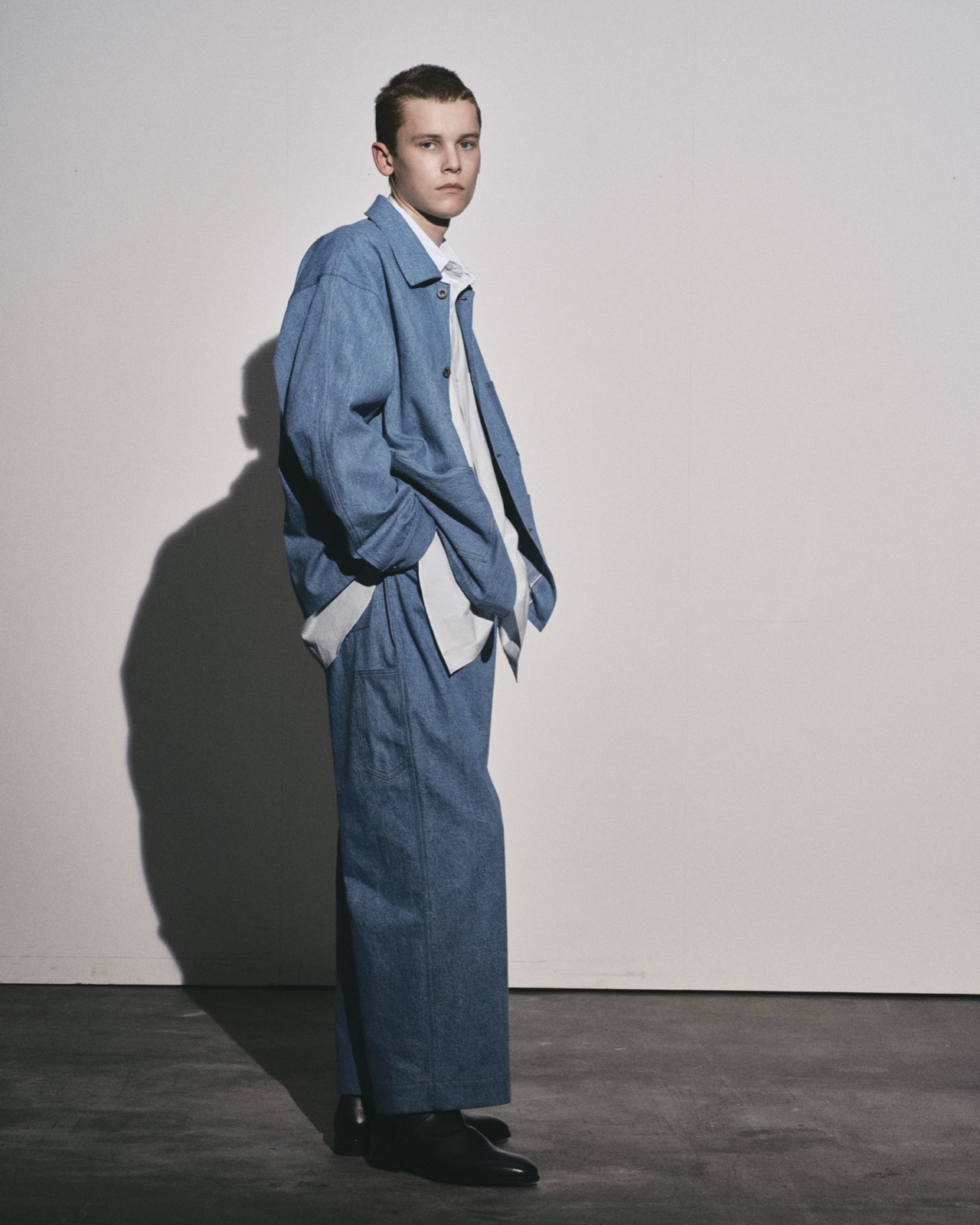
Editorial · Brand Feature
AMOSKEAG
History ReworkedThrough fabric
- Conversation with
- Mr. Kaneda (Founder & Designer)
- Written by
- Sakura Yamamoto

Chapters
- 01AMOSKEAG /ˈæm.əsˌkiːɡ/
- 02Interpretation, not reproduction
- 03Fabric first, developed with Japanese mills
- 04Between casual and structured
- 05An American textile name, seen from Japan
- 06The process behind AMOSKEAG
- 07Not defined by denim
- 08Cloth that settles over time
- 09The garment before the designer
- ·Honmono notes
Chapter 1AMOSKEAG /ˈæm.əsˌkiːɡ/
AMOSKEAG takes its name from a textile company that ran mills in Manchester, New Hampshire, from 1831 until 1935. Its fabrics were part of the early history of American denim and workwear, and that history is where the new label starts.
Before it was a contemporary label, Amoskeag was one of the great names of American textiles. The Amoskeag Manufacturing Company was incorporated in 1831 in Manchester, New Hampshire, and its mills supplied the denim for Levi Strauss's riveted jeans until around 1915.
The mills were built to use the power of the Merrimack River, and by the late 19th century Amoskeag was the largest cotton textile plant in the world, employing up to 17,000 people at its peak before the First World War. Its importance lay less in any single garment than in a system: weaving, finishing and distributing standardised cloth on an industrial scale.
In the 20th century the company lost ground to newer mills in the American South, powered by electricity rather than water and paying lower wages, and Levi's turned to Cone Mills for its denim. Long strikes and then the Great Depression weakened Amoskeag further, and it filed for bankruptcy on Christmas Eve 1935.
That history is the starting point for the contemporary AMOSKEAG. Rather than beginning with finished clothing or familiar vintage codes, the brand goes back to the cloth itself, and to the manufacturing decisions that determine what a garment can become.


Chapter 2INTERPRETATION, NOT REPRODUCTION
The project does not copy old garments. It studies the qualities of old cloth, especially greige (raw, unfinished) fabric made before modern finishing processes, and carries them into contemporary clothing.
AMOSKEAG looks beneath the surface of historical garments. The interest is less in recognisable silhouettes than in what made the clothes work: the density of the cloth, the instability of raw fabric, the logic of utility, and the way construction answered to daily use.
Much of the old fabric's character came from what it lacked. It was made before sanforizing (which controls shrinkage) and skew correction (which stops the legs of a pair of trousers twisting) became standard. Without them, cloth shrank unevenly, moved and twisted, and had a texture that ordinary modern production rarely produces.
AMOSKEAG works from that material condition. The aim is to keep the strength of the cloth while giving it a new form: a garment that carries its history through fabric, washing and proportion rather than through imitation.


Chapter 3FABRIC FIRST, DEVELOPED WITH JAPANESE MILLS
Each piece begins with the textile rather than a fixed design. The garment follows the behaviour of the fabric: its weight, tension, surface, shrinkage, and the way it changes through washing and wear.
Fabrics are developed with Japanese mills, and the brand settles how a cloth behaves before deciding on any final form. Density, surface, structure, shrinkage and hand feel are treated as design decisions in their own right.
The main fabrics:
Moleskin: dense yet soft, woven from fine yarns with a quiet sheen, washed at the fabric stage for softness and body.
Oxford: yarn-dyed and washed as a full roll after weaving, so uneven shrinkage leaves creases across the surface that soften and mark with wear.
Whipcord: a steep twill traditionally used for hard-wearing workwear, made here in a salt-and-pepper mix and washed until slightly soft, with a pronounced rib.
Greige: kept close to its raw state, with its irregularities left in.
Denim: used sparingly, only when a cloth justifies a return to such a familiar category.
The fabric is not chosen to fit a finished design. The design starts from the fabric.


Chapter 4BETWEEN CASUAL AND STRUCTURED
AMOSKEAG draws on American workwear, but through proportion, cloth and silhouette rather than direct quotation.
Other influences can be felt, particularly the restraint and balance of Japanese collections of the 1990s. They are never stated outright. They show in the way a shoulder falls, how volume is distributed, and how a garment avoids looking overdesigned.
The clothes keep the elements of utility: durable fabrics and functional details. But they are cut with a quieter, urban sensibility, sitting somewhere between casual and structured.
The result is hard to file under a genre. What defines it is how each garment sits on the body, how the material settles over time, and how easily it becomes part of everyday wear.


Chapter 5AN AMERICAN TEXTILE NAME, SEEN FROM JAPAN
The label began when a Japanese textile company was entrusted with the rights to the Amoskeag name. It did not use them straight away. The question was how to inherit a textile history without reducing it to a logo or a reproduction line.
That pause was necessary. The name carries a specific industrial memory, from the mills on the Merrimack to the denim made for Levi's, and a kind of cloth produced before today's finishing standards.
Only after studying that history did a direction emerge. AMOSKEAG would not be a straightforward revival. It would take up an American textile history through Japanese fabric development and close attention to process.
Today every AMOSKEAG garment is made in Japan, where the value of a piece is judged by its fabric, washing, proportion and making.


Chapter 6THE PROCESS BEHIND AMOSKEAG
01STARTING FROM THE HISTORY
The work begins with the Amoskeag mills and the cloth they produced. The aim is not to quote that history visually, but to understand what made the fabric distinctive.
02WORKING WITH RAW CLOTH
The team focuses on the qualities of greige fabric: irregularity, instability, shrinkage and texture. They are difficult to work with directly, but they give the material its depth.
03PROCESSING BEFORE ASSEMBLY
Washing and other treatments are applied to the fabric before it is cut and sewn, rather than to the finished garment. The cloth keeps its character but becomes stable enough to wear.
04BRINGING IT INTO THE PRESENT
Once the fabric is resolved, silhouette and proportion are refined for contemporary wear.


Chapter 7NOT DEFINED BY DENIM
Given the mill's place in early denim history, AMOSKEAG could have built itself around jeans from the start. It chose not to treat denim as the obvious answer.
The team set itself a rule: no standard five-pocket jeans until the fabric was fully resolved. Development starts with other cloths and comes back to denim only on its own terms.
Denim remains part of the vocabulary, but never as a shortcut. What matters is whether the fabric has enough character and structure to justify the garment.
The restraint keeps AMOSKEAG from being defined by the most obvious part of its history, and keeps attention on cloth, manufacturing and wear as a whole.


Chapter 8CLOTH THAT SETTLES OVER TIME
AMOSKEAG is shaped by the behaviour of raw cloth: shrinkage, twisting, irregularity and surface. The garments are meant to settle and show their structure through time and repeated wear.
Reviving the feel of unfinished fabric directly causes problems. Shrinkage varies, the cloth can behave unpredictably, and a garment can look worn too quickly. Washing the fabric before it is sewn is AMOSKEAG's answer.
The cloth keeps its character and becomes wearable, and the garment is judged less on first impression than on how it settles and changes with use. On the Oxford trousers, for example, the creases left by washing the fabric are meant to fade and mark over years of wear. Ageing is part of how the garment is finished.


Chapter 9The garment before the designer
AMOSKEAG deliberately keeps its designer in the background, so that nothing distracts from the clothes.
Without a designer's story laid over them, attention moves to fabric, construction, proportion and process. Each garment has to stand on its own.
This changes how the brand is read. Instead of presenting clothing as one person's expression, AMOSKEAG puts the weight on the shared work of making: the mill, the pattern, the wash, the sewing, and finally the person who wears it.


Honmono notes
AMOSKEAG treats heritage as something to work with rather than preserve. Its strength is the patience of its process and its refusal to use history as decoration.
AMOSKEAG is developed by BUG INDUSTRY in Tokyo, and what sets it apart is less the name it borrows than the discipline with which that reference is handled.
Instead of relying on familiar codes, the team took its time: to understand the name, test materials, and settle on a direction that could last beyond a single collection.
The result is clothing that is not driven by trend or category. Workwear, fabric, silhouette and manufacturing come together without being forced into a label, and the brand sets out to make clothes with the same attention to how things are made as the mills whose name it carries.


Where to find AMOSKEAG